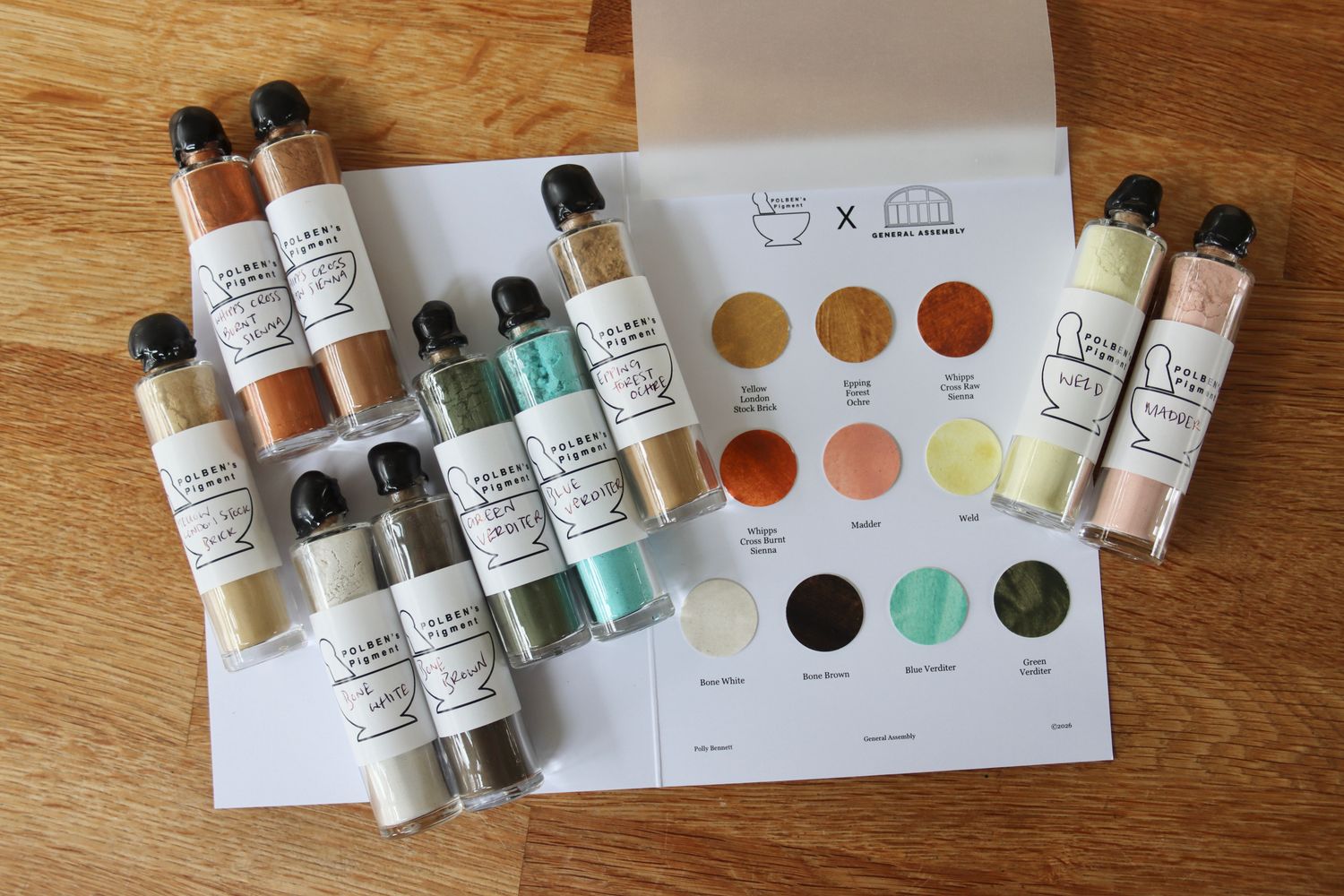
POLBEN's Pigment X General Assembly Layers of London Pigment Set
£250.00
In stock
Product Details
POLBEN's Pigment (Polly Bennett) and General Assembly present the Layers of London Pigment Set, a collaborative project where artists have been selected to create work with the pigments for a group exhibition in September 2026 at General Assembly London. You can now join in on the collaboration by purchasing your very own Layers of London Pigment Set to produce work made by materials foraged in and linked to our capital city, London.
Included in the set are ten 30ml vial pigments all with links to London:
Yellow London Stock Brick - An iconic London brick, characterised by its yellow colour, sandy texture, and black spots produced in the firing process. Predominantly used in London and the South East since the Georgian and Victorian eras.
Epping Forest Ochre - Clay dug in Epping Forest.
Whipps Cross Raw Sienna - A particularly sandy, iron-rich clay dug from the banks of Hollow Pond near Whipps Cross.
Whipps Cross Burnt Sienna - Produced by heating (calcining) Whipps Cross Raw Sienna to produce hematite.
Madder - The historical dye plant that produces red, pink and orange lake pigments when precipitated with mordants. Madder is grown at Chelsea Physic Garden.
Weld - A dye plant foraged in South London that produces a yellow lake pigment.
London has a rich history of dye houses, including, the still standing, Dyers’ Company; one of the City of London's ancient Livery Companies.
Bone White - One of our most ancient pigments, the use of bone pigments can be seen in cave paintings all over the world. Animal bones, foraged all over London as waste and roadkill, were calcined in a fire-pit and transformed into bone ash or bone white.
Bone Brown - Calcined in a sealed container, in a fire-pit, these bones were starved of oxygen to produce a sooty, dark chocolate brown pigment.
Green Verditer - A synthesised, green copper carbonate pigment chemically similar to malachite - a copper mineral - that was developed by silver refiners as a byproduct of their refinement process. It was introduced in the 16th century, refined in the 17th-century, and later heavily used by 18th-century English colour-makers.
Blue Verditer - A synthesised, light blue pigment chemically similar to azurite - a copper mineral - that became a significant English innovation in the 17th century. While the name derives from vert de terre “green of earth”, English colour-makers perfected the formula for the blue version, which previously had been an unreliable process. In fact it became one of England's most significant contributions to pigment innovation. Please note, if using an oil binder, blue verditer can shift to green.
Health & Safety:
When using airborne pigments please use a facemask. If prone to sensitive skin, please wear gloves when airborne. Please always use gloves, as well as your mask, when using verditer as it is toxic - due to its copper content - and can cause irritable skin.
Do not ingest pigments.
Please note these pigments are handmade and each batch might vary slightly in shade.
THIS PRODUCT IS MADE TO ORDER AND CAN REQUIRE UP TO 3 WEEKS TO CREATE AND DISPATCH.
Buyers shipping to America are responsible for any tariffs, duties and fees that may apply.